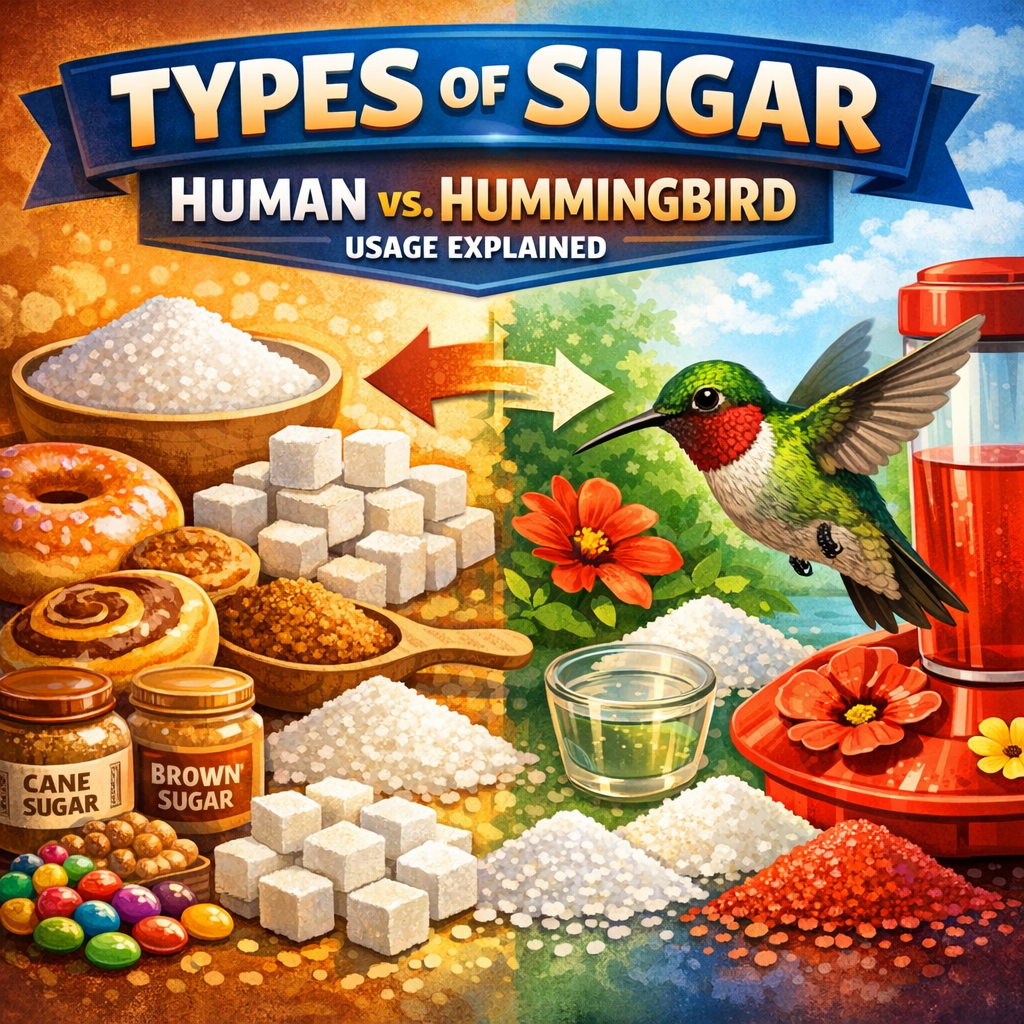
Types of Sugar: Human vs. Hummingbird Usage Explained
Understanding Different Types of Sugar and Their Use in Humans and Hummingbirds
Sugar, in its many forms, is a fundamental component of the diet for many organisms, including humans and hummingbirds. Each utilizes these sugars in unique ways, driven by their distinct metabolic needs. This post will explore the various types of sugar, how they are processed by the human body, and contrast that with sugar metabolism in hummingbirds.
Types of Sugar
Sugar is not a one-size-fits-all substance. There are several types, each with its own structure and function:
1. Simple Sugars (Monosaccharides)
- Glucose: Often referred to as blood sugar, it is crucial for generating energy.
- Fructose: Found in fruits and honey, it has a sweeter taste than glucose.
- Galactose: Typically less sweet, found primarily in milk and dairy products.
2. Double Sugars (Disaccharides)
- Sucrose: Common table sugar, composed of glucose and fructose.
- Lactose: The sugar in milk, made up of glucose and galactose.
- Maltose: Formed from two glucose molecules, found in germinating seeds.
3. Complex Carbohydrates (Polysaccharides)
- Starch: A storage form of glucose in plants.
- Glycogen: The storage form of glucose in humans and animals.
- Cellulose: Makes up the cell wall in plants, indigestible by humans.
How Humans Use Sugar
In humans, sugars are primarily used for energy. Here’s how the body processes these sugars:

Absorption and Digestion
- Simple Sugars: Quickly absorbed into the bloodstream, causing rapid increases in energy.
- Complex Carbohydrates: Broken down into simple sugars before absorption; this slower process provides sustained energy.
Metabolic Pathways
- Glycolysis: The pathway through which glucose is broken down to produce energy.
- Insulin Regulation: Insulin helps regulate blood glucose levels, storing excess glucose as glycogen.
Energy Storage
- Excess sugar in the human body is stored as fat or glycogen in the liver and muscles, serving as a later energy reserve.
How Hummingbirds Use Sugar
Hummingbirds have an incredibly high metabolism that suits their rapid wing flapping during flight. They consume mainly nectar, which is rich in sucrose, and their sugar metabolism differs significantly from humans:
Rapid Absorption
- Hummingbirds can absorb sugar directly through the wall of their throats, allowing them to access energy almost immediately.
Energy Conversion
- Unlike humans, hummingbirds do not rely heavily on insulin for sugar regulation. They can convert sucrose directly into energy without the prolonged breakdown process.
Fat Storage
- While humans store excess sugars as fat, hummingbirds primarily use the immediate energy to maintain their high metabolic rate. They rarely store fat due to their continual energy expenditure.
Key Differences Between Humans and Hummingbirds
The primary differences in how humans and hummingbirds use sugar are evident in their metabolic rates, methods of sugar absorption, and energy storage strategies. Humans process and store sugars for long-term use, while hummingbirds are adapted for immediate energy conversion to support sustained flight.
Metabolic Rate
- Humans: Relatively slow, which aligns with our less active lifestyles compared to hummingbirds.
- Hummingbirds: Extremely high, to support their energy-intensive flying behavior.
Energy Utilization
- Humans: Energy is used gradually, with excess stored for future use.
- Hummingbirds: Almost all consumed energy is used immediately due to constant, high-speed activity.
In conclusion, while both humans and hummingbirds consume sugars, the types they utilize and how they metabolize them differ greatly, reflecting their distinct biological needs and lifestyles. Understanding these differences not only highlights the adaptability of biological systems but also underlines the specialized strategies that different organisms have evolved to meet their energy needs.