Hummingbird Secrets: Stunning Tongue Mysteries Revealed!
How Long is a Hummingbird’s Tongue?
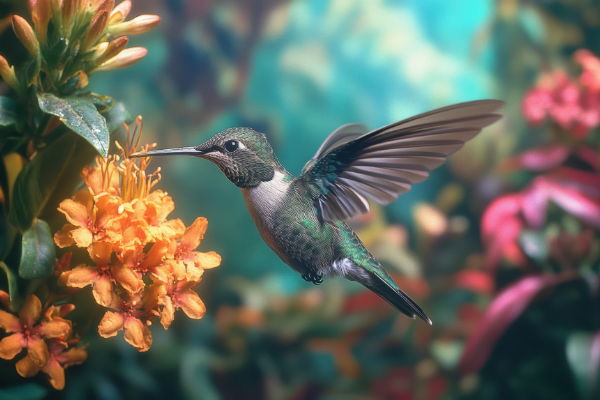
Surprisingly, the elegance of hummingbirds does not stop at their iridescent feathers and rapid wing movements; their tongues are equally fascinating. Hummingbirds, known for their diminutive size and incredible agility in flight, have tongues that are a marvel of nature, designed explicitly for accessing nectar deep within flowers.
The Astonishing Length and Storage
Believe it or not, the length of a hummingbird’s tongue is typically much longer than you might expect. It averages about twice the length of their beaks. In some species, this means the tongue can be up to 4 centimeters long, a significant measurement considering that the bird itself is often only 8 to 10 centimeters from beak to tail.
Given their small body size, one might wonder where exactly this lengthy tongue is stored when not in use. Nature has crafted a perfect solution for this. The tongue itself, when retracted, coils at the rear of the head and extends into the throat. This unique structural adaptation is facilitated by the flexible bone structure that surrounds the skull and upper beak. This anatomy allows the tongue to be neatly tucked away and efficiently unfurled when the bird reaches into a flower for nectar.

Retrieving Nectar: A Mechanical Wonder
The mechanism by which hummingbirds retrieve nectar using their long tongues is as intriguing as their storage solution. Far from being a simple siphon or straw, the hummingbird’s tongue operates on a principle of microfluidics that scientists have only recently begun to thoroughly understand.
Initially, it was believed that hummingbirds’ tongues worked like a capillary tube, using the principle of capillary action to draw liquid upwards. However, more detailed observations and studies have revealed a more complex mechanism at play. Hummingbird tongues actually have a pair of tube-like structures that open out when they hit the nectar and close upon withdrawal. When a hummingbird inserts its tongue into a flower, these grooved tubes spread open as the tongue extends, allowing nectar to be trapped in these micro-grooves. As the tongue is retracted, the tips of these grooves close, trapping the nectar and allowing the bird to pull it back into its mouth.
Evolutionary Adaptations for Efficiency
The evolution of such a sophisticated tongue mechanism highlights the intricate relationship between hummingbirds and the flowers they pollinate. This co-evolution has led to mutual benefits; flowers are pollinated while hummingbirds receive the nectar they need for high energy sustenance. This relationship has directly influenced the physiological adaptations seen in both parties, reflecting the dynamics of natural selection.
Moreover, the efficiency of the hummingbird’s feeding process is critical, given their high energy expenditure. Hummingbirds beat their wings up to 80 times per second, which makes for a colossal metabolic rate. Having such an effective tool to feed quickly and move onto the next source of nectar is vital for their survival.
Final Thoughts
The hummingbird’s tongue is not just a feeding mechanism but a symbol of evolutionary innovation. It represents a biological solution to environmental challenges, highlighting nature’s capacity to evolve traits that ensure survival in specific niches. The hummingbird, with its sparkling feathers and rapid wing beats, thus not only captivates the casual observer but also offers deep insights into the mechanics of evolution and adaptation. Their seemingly simple act of feeding is a testament to the complexity and wonder of natural design, reminding us of the intricate connections that sustain life on our planet.